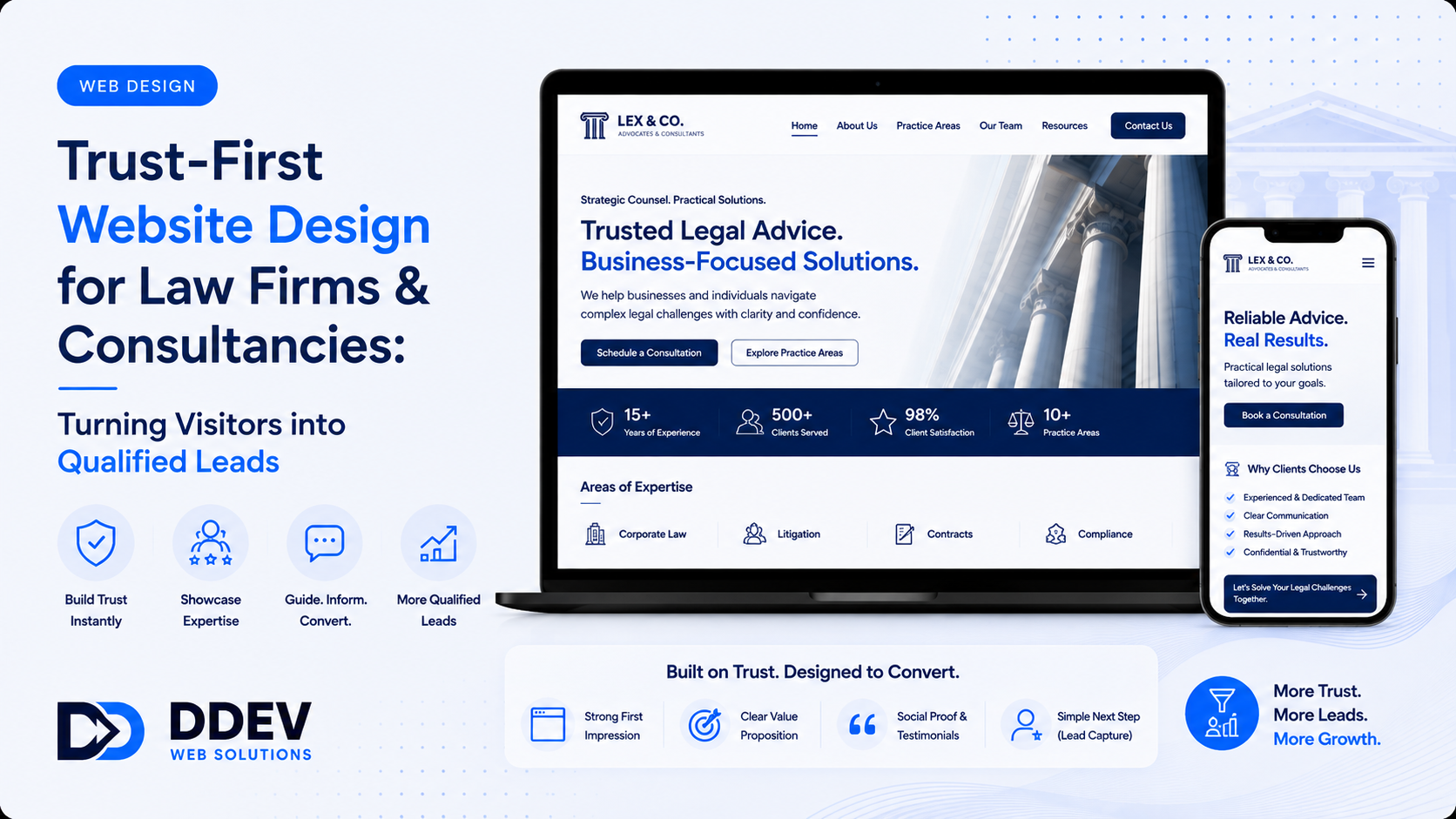
Trust-First Website Design for Law Firms & Consultancies: Turning Visitors into Qualified Leads
For professional services like law firms and consultants, trust is the product. Here is how to design a website that communicates authority and credibility.
A potential client searches "corporate lawyer in Bangalore" or "tax consultant near me." They find your website. In the next 5-10 seconds, they decide whether you seem trustworthy enough to call.
For professional services — law firms, CA practices, financial advisors, management consultants — trust is the product. If your website does not communicate credibility, competence, and professionalism instantly, no amount of expertise behind it matters.
Most professional service websites in India fail this test. They are either generic WordPress templates that look like every other firm, or overbuilt corporate sites with stock images of handshakes and skylines.
A trust-first website is designed specifically to make a visitor think: "This firm looks serious. I should talk to them."
What "Trust-First" Means in Practice
1. Credentials Above the Fold
The first thing a visitor should see: who you are, what you specialize in, and why you are qualified. Not a generic tagline ("Solutions for Tomorrow"). Specifics.
"15 years of corporate law practice. 200+ M&A transactions. Former partner at [reputable firm]."
For CA firms: "Serving 500+ SMBs across India. GST, income tax, and audit specialists since 2010."
2. Individual Practitioner Profiles
Clients hire people, not firms. Each partner/senior professional needs a detailed profile including qualifications and bar council/ICAI registration, years of experience and specialization areas, notable matters or clients (with consent), a professional headshot (not a stock image), and published articles, speaking engagements, or media mentions.
3. Practice Area Pages
A single "Services" page listing everything is not enough. Each practice area needs its own page — "GST Compliance and Advisory," "Mergers & Acquisitions Law," "RERA and Real Estate Legal Services," "Startup Legal Advisory."
Each page should explain what you do, who it is for, your approach, and include a consultation CTA. These pages also rank for specific search queries.
4. Client Testimonials and Case Studies
Social proof is the most powerful trust signal for professional services. Display client testimonials with names and companies (with consent), anonymized case studies showing the problem, your approach, and the outcome, and client logos (with permission) — recognized names build instant credibility.
5. Content That Demonstrates Expertise
A blog or resources section with articles on relevant topics — "Changes in GST Filing for FY 2026-27" or "Due Diligence Checklist for First-Time Startup Founders" — positions your firm as a thought leader, not just a service provider.
This content also drives organic search traffic from potential clients researching their legal or financial questions.
6. Clear, Low-Friction CTAs
"Schedule a Free 15-Minute Consultation" works better than "Contact Us." A short booking form (name, phone, brief description of need) captures leads. A click-to-WhatsApp button provides an alternative for clients who prefer messaging.
What Professional Service Websites Get Wrong
Stock imagery. A photo of a gavel, scales of justice, or people in suits shaking hands tells visitors nothing about your firm. Use real photos.
No pricing guidance. "Contact us for a quote" frustrates potential clients. Even a starting range ("Initial consultations from ₹2,000") sets expectations and filters for serious inquiries.
Buried contact info. Phone number and consultation booking should be visible on every page — not just buried on a Contact page.
Too formal. Legal and financial language on websites should be precise but accessible. If a potential client cannot understand your service descriptions, they will not call.
No mobile optimization. 60%+ of searchers are on phones. A desktop-only website loses more than half its potential clients.
Local SEO for Professional Services
Target keywords: "[service] in [city]" — "corporate lawyer in Mumbai," "CA firm in Jaipur," "tax consultant in Hyderabad."
Google Business Profile: Complete, verified, with correct categories (e.g., "Law Firm," "Chartered Accountant"). Collect Google Reviews from clients.
Directory listings: IndiaMART, Justdial, Sulekha, and industry-specific directories (e.g., AdvocateKhoj for lawyers).
Schema markup: LegalService, FinancialService, or ProfessionalService schema helps Google understand your firm.
Frequently Asked Questions
How much does a law firm website cost in India?
A professional website with practitioner profiles, practice area pages, testimonials, and lead capture costs ₹60,000-₹2,00,000. With a client portal, ₹1,50,000-₹3,00,000.
Do professional service firms really need SEO?
Yes. "[Service] in [city]" searches have high commercial intent. A firm ranking for "tax consultant in Pune" receives qualified leads without advertising spend.
Should I have a blog on my firm's website?
Absolutely. Articles on relevant legal or financial topics drive organic traffic, demonstrate expertise, and build trust with potential clients who are researching their issues before hiring a professional.
Build a Website That Earns Trust Before the First Call
DDev designs websites for law firms, CA practices, and consultancies — trust-first architecture with practitioner profiles, practice area pages, lead capture, and client portals.
Talk to DDev About Your Professional Website.