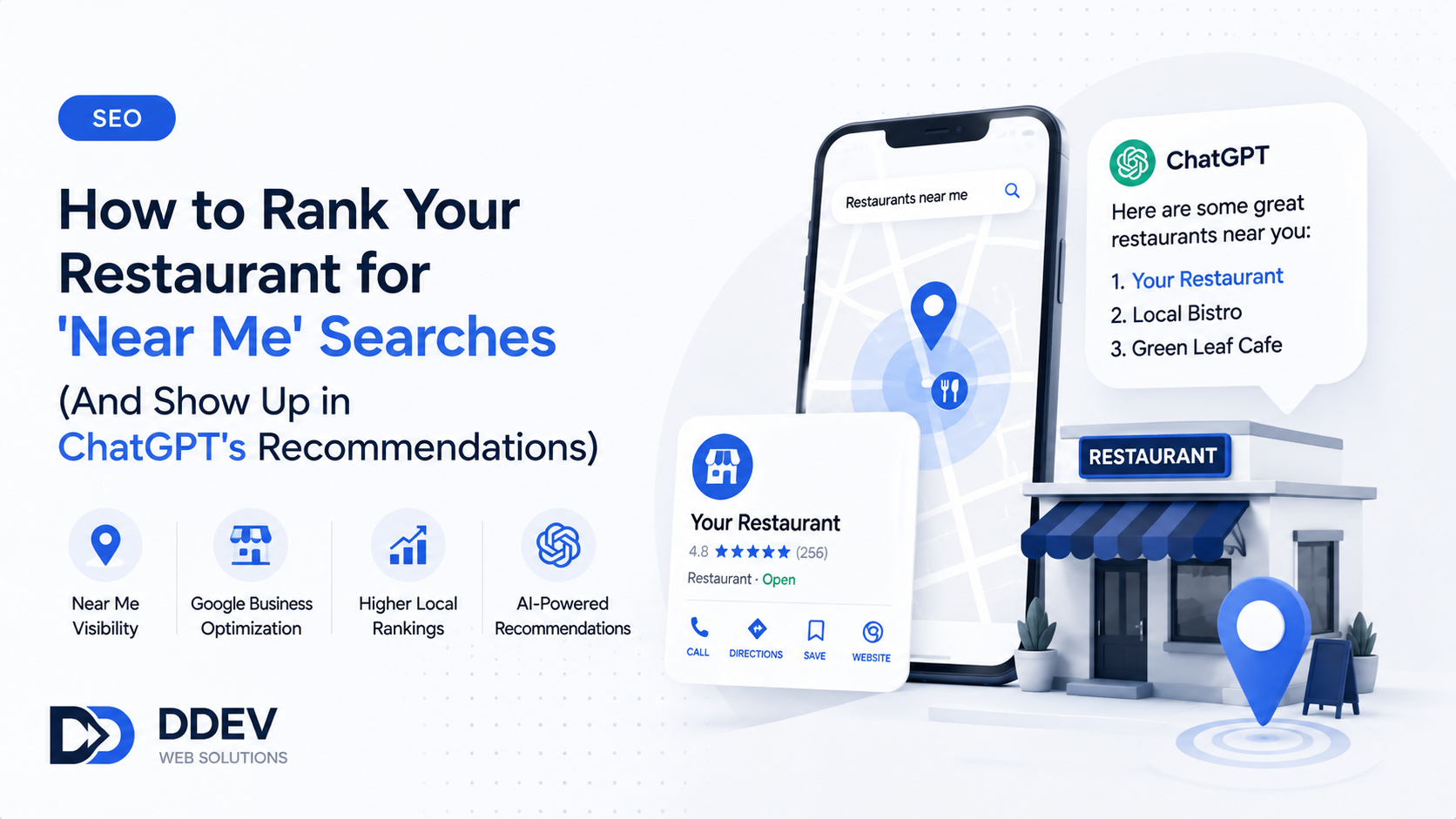
How to Rank Your Restaurant for 'Near Me' Searches (And Show Up in ChatGPT's Recommendations)
76% of 'near me' searchers visit a business within 24 hours. Here is the step-by-step playbook to rank your restaurant on Google and AI search engines.
"Best biryani near me."
That search happens thousands of times a day across India. And the restaurants that show up in the top 3 results — the Google Maps "Local Pack" — get the overwhelming majority of clicks, calls, and walk-ins.
The ones below? They might as well not exist.
76% of people who search for something "near me" visit a related business within 24 hours. 28% of those local searches result in a purchase. These numbers have been consistent across Google's own research for years, and they explain why local SEO is not optional for restaurants — it is the single highest-return marketing activity you can do.
But here is what has changed in 2026: "near me" searches are no longer just happening on Google. They are happening on ChatGPT, Google's AI Overviews, Perplexity, and Gemini. When someone asks an AI "best butter chicken in Koramangala," the AI pulls from a different set of signals than the traditional search algorithm.
This guide covers both: how to rank on Google Maps and how to show up when AI recommends restaurants.
Why "Near Me" Is the Most Valuable Search Your Restaurant Can Win
Consider the intent behind these two searches:
- "How to make paneer tikka" → This person wants a recipe. They are cooking at home.
- "Paneer tikka near me" → This person wants to eat. Right now. They are ready to spend money.
The second search has direct commercial intent. The person has already decided to eat out or order — they are just picking where.
Restaurants that rank for "[dish/cuisine] near me" and "[restaurant type] in [neighborhood]" are capturing customers at the exact moment of decision. No ad spend needed. No aggregator commission.
Google's Local Pack — the map with three listings that appears at the top of local searches — gets roughly 42% of all clicks. If your restaurant is not in that pack, your competitor is.
Google Business Profile: The Foundation
Your Google Business Profile (GBP) is the single most important ranking factor for local search. Not your website. Not your Instagram. Your GBP listing.
Here is how to optimize it properly:
Complete every field
Google rewards completeness. Fill out every section:
- Business name — Exact legal name. Do not stuff keywords here ("Raj's Kitchen — Best Biryani in Hyderabad" will get you penalized).
- Category — Primary category (e.g., "Indian Restaurant") plus relevant secondary categories (e.g., "Biryani Restaurant," "Delivery Restaurant").
- Address — Exact, consistent address. Must match your website and every other listing exactly.
- Phone number — A local number, not a toll-free or virtual number.
- Hours — Keep these updated. Wrong hours lead to negative reviews.
- Website URL — Links to your actual website, not your Zomato page.
- Menu link — Critical. Link to a real menu page on your website, not a PDF.
- Attributes — Dine-in, takeaway, delivery, outdoor seating, wheelchair accessible. Check everything that applies.
Photos — Updated Weekly
Restaurants with photos on their GBP get 42% more direction requests and 35% more click-throughs to their website than those without.
Upload:
- High-quality food photos (your actual dishes, not stock images)
- Interior and exterior shots
- Team photos
- New specials and seasonal dishes
Upload at least 2–3 new photos per week. Google treats fresh photo activity as a ranking signal.
Google Posts — Weekly
GBP Posts let you publish updates directly on your listing. Use them for:
- New menu items
- Weekend specials
- Festival offers
- Events
Posts expire after 7 days, so weekly posting keeps your listing active. Activity signals freshness to Google's algorithm.
Your Website: The Conversion Layer
Your GBP gets you visibility. Your website converts that visibility into orders, reservations, and calls.
A restaurant website needs to do three things fast:
1. Load in under 3 seconds on mobile
More than 60% of restaurant searches happen on phones. If your site takes 5 seconds to load, you have already lost half your visitors. Google's own data shows 53% of users leave a page that takes more than 3 seconds.
Compress images. Use a fast host. Strip unnecessary scripts.
2. Show the menu immediately
The menu is the #1 reason people visit a restaurant website. It should be accessible in one tap from the homepage — not buried in a PDF that requires downloading and pinch-zooming on a phone screen.
Build your menu as an HTML page with structured data, not a scanned PDF image.
3. Make ordering or reserving effortless
Above-the-fold CTAs: "Order Now" and "Reserve a Table." Both should work on mobile without friction.
If your website does not have online ordering, you are sending every visitor back to Swiggy to order — and paying 25–35% commission for the privilege.
Menu Schema: Speaking Google's Language
Schema markup is structured code that tells Google exactly what your page contains. For restaurants, menu schema is particularly powerful because it helps Google understand your dishes, prices, and categories — and display them directly in search results.
In practice, restaurant schema defines your business as a Restaurant type, with structured fields for cuisine, address, and a full menu broken into sections and items — each item carrying its own name, description, and price in a format search engines and AI systems can parse directly, rather than having to guess from a photo or PDF.
This structured data helps Google (and AI engines) understand your menu at a granular level. When someone searches "paneer tikka in Koramangala under ₹300," a schema-rich menu page has a real shot at showing up.
Most restaurant websites in India do not use schema. This is a genuine competitive advantage if you implement it.
Reviews: The Trust Signal That Drives Rankings
Google's local ranking algorithm weighs three things heavily:
- Relevance — Does your listing match what the person searched?
- Distance — How close are you to the searcher?
- Prominence — How well-known and well-reviewed is your business?
You cannot control distance. Relevance is handled by a complete GBP listing. Prominence is where reviews come in.
Quantity matters. A restaurant with 500 reviews will outrank one with 50, all else being equal.
Recency matters. A restaurant with 10 reviews this month ranks better than one with 10 reviews six months ago.
Response matters. Reply to every review — positive and negative. Google treats owner responses as an engagement signal.
How to get more reviews without being annoying
- Print a QR code linking to your Google review page on the bill or table card
- Train servers to ask satisfied customers: "If you enjoyed the meal, a Google review helps us a lot"
- Send a WhatsApp message after delivery orders with a review link
- Never offer incentives for reviews — Google's policy prohibits it and it risks getting reviews removed
The New Layer: AI Search and Answer Engines
Here is what has changed in 2026: people increasingly ask AI assistants for restaurant recommendations instead of (or before) searching Google.
"Hey ChatGPT, what's the best South Indian restaurant in Indiranagar for a family dinner?"
"Gemini, recommend a good biryani place near Hitech City under ₹400 for two."
AI engines answer these questions by pulling from:
- Structured web data — Schema markup, menu pages, well-organized website content
- Reviews and ratings — Google reviews, Zomato reviews, aggregated sentiment
- Authoritative mentions — Blog posts, food blogger reviews, press coverage, local directories
- Freshness signals — Recent content, updated information, active online presence
What this means for your restaurant
- A well-structured website matters even more. AI engines can parse a clean HTML menu page with schema. They struggle with PDFs and image-only content.
- Third-party mentions are valuable. If a food blogger writes about your restaurant and links to your website, that mention becomes data the AI can cite.
- Google Business Profile activity feeds AI. Google's own AI Overviews pull heavily from GBP data — photos, reviews, posts, and attributes.
- Consistency across platforms helps. If your name, address, cuisine type, and specialties are consistent across your website, GBP, Justdial, and social media, AI engines have higher confidence in recommending you.
This is still an emerging field — nobody has it fully figured out. But the fundamentals (structured data, reviews, consistent information, fresh content) align with what you should already be doing for traditional SEO.
A 30-Day Local SEO Action Plan
Week 1: Foundation
- Claim and verify your Google Business Profile if you have not already
- Complete every field — categories, attributes, hours, menu link, website
- Upload 10+ high-quality photos (food, interior, exterior)
- Fix your NAP (Name, Address, Phone) consistency across website, GBP, Justdial, and social media
Week 2: Website
- Build an HTML menu page with prices (not a PDF)
- Add Restaurant and Menu schema markup
- Ensure your site loads in under 3 seconds on mobile
- Add "Order Now" and "Reserve" CTAs above the fold
Week 3: Reviews
- Print QR code review cards for tables and bills
- Respond to every existing Google review (start with the last 30 days)
- Set up a post-delivery WhatsApp message with a review request link
Week 4: Content and Ongoing
- Publish your first Google Post (weekend special or new dish)
- Create one blog post or page targeting "[your cuisine] in [your neighborhood]"
- Schedule weekly GBP posts and 2–3 new photo uploads per week
- Monitor your GBP Insights for search queries, views, and actions
Results from local SEO typically take 4–8 weeks to show initial movement. Consistency is the multiplier — restaurants that post, upload photos, and collect reviews weekly outperform those that optimize once and forget.
Frequently Asked Questions
How long does it take for local SEO to work for a restaurant?
Initial movement in Google Maps rankings typically takes 4–8 weeks. Significant, stable ranking improvements usually take 3–6 months of consistent activity — weekly GBP posts, regular photo uploads, and steady review collection.
Is Google Business Profile really more important than my website?
For local "near me" searches, yes. GBP is the primary ranking factor for the Local Pack (the map results). Your website is the secondary layer that converts clicks into orders and reservations. You need both.
Do I need a blog for my restaurant website?
A blog is not essential, but 1–2 well-written pages targeting "[cuisine/dish] in [neighborhood/city]" can capture long-tail searches that bring in new customers. Think of it as creating pages that answer the exact questions people are typing into Google.
How does AI search affect restaurant discovery?
AI assistants like ChatGPT, Gemini, and Google's AI Overviews are increasingly used for restaurant recommendations. They pull from structured website data, reviews, and third-party mentions. Restaurants with clean, schema-rich websites and strong review profiles are more likely to be recommended by AI.
Should I list my restaurant on Justdial, Yelp, and other directories?
Yes. Consistent listings across multiple directories (with matching NAP information) strengthen your local SEO signals. Justdial, Sulekha, and industry-specific directories are all worth listing on — they take 10 minutes each.
Your Restaurant Deserves to Be Found — On Google and By AI
DDev builds fast, schema-rich restaurant websites designed to rank in local search and get recommended by AI engines. Menus, online ordering, reservations, and local SEO — all on your own domain.
Get Your Restaurant Found. Talk to DDev.