Restaurant Website vs. Just a Zomato Listing: Why You Need to Own Your Menu, Reservations & Customer Data
On Zomato, the customer belongs to Zomato. On your website, the customer belongs to you. Here is why owning your restaurant's digital presence matters.
If you asked most restaurant owners whether they have a "digital presence," they would say yes — and point to their Zomato or Swiggy listing.
They are not wrong. A Zomato listing is a digital presence. It has your menu, photos, reviews, and a way for customers to order.
But here is what it is not: yours.
You are renting space on someone else's platform, playing by their rules, paying their commission, and — most critically — handing over your customer relationships to a company whose interests will never fully align with yours.
This is the difference between renting customers and owning them. And over time, that difference becomes the difference between a restaurant that grows and one that stays stuck.
The Renting vs. Owning Problem
When a customer orders from you on Zomato, here is what happens:
- Zomato processes the order
- Zomato collects the payment
- Zomato owns the customer's contact information
- Zomato takes 18–28% commission (25–35% effective after fees)
- The customer's loyalty is to the app, not to you
When that same customer orders from your website:
- You process the order
- Your payment gateway handles the transaction (at 2% — not 25%)
- You own the customer's phone number, order history, and preferences
- You can re-market to them via WhatsApp, SMS, or email
- Their loyalty starts building toward your brand
The first model is renting. The second is owning.
Every restaurant starts by renting — and there is nothing wrong with that. Aggregators give you visibility you cannot build overnight. But restaurants that never transition to owning hit a ceiling: they grow their revenue on paper while their margins stay flat because the platform's cut grows with them.
What You Lose on a Marketplace
1. Customer Relationships
On Zomato, the customer's phone number is masked. You see an order, not a person. You cannot text them about a new dish, send them a birthday offer, or remind them to order on a quiet Tuesday evening.
Zomato can. And Zomato will — but to promote your competitor if they are running a bigger ad.
2. Pricing Control
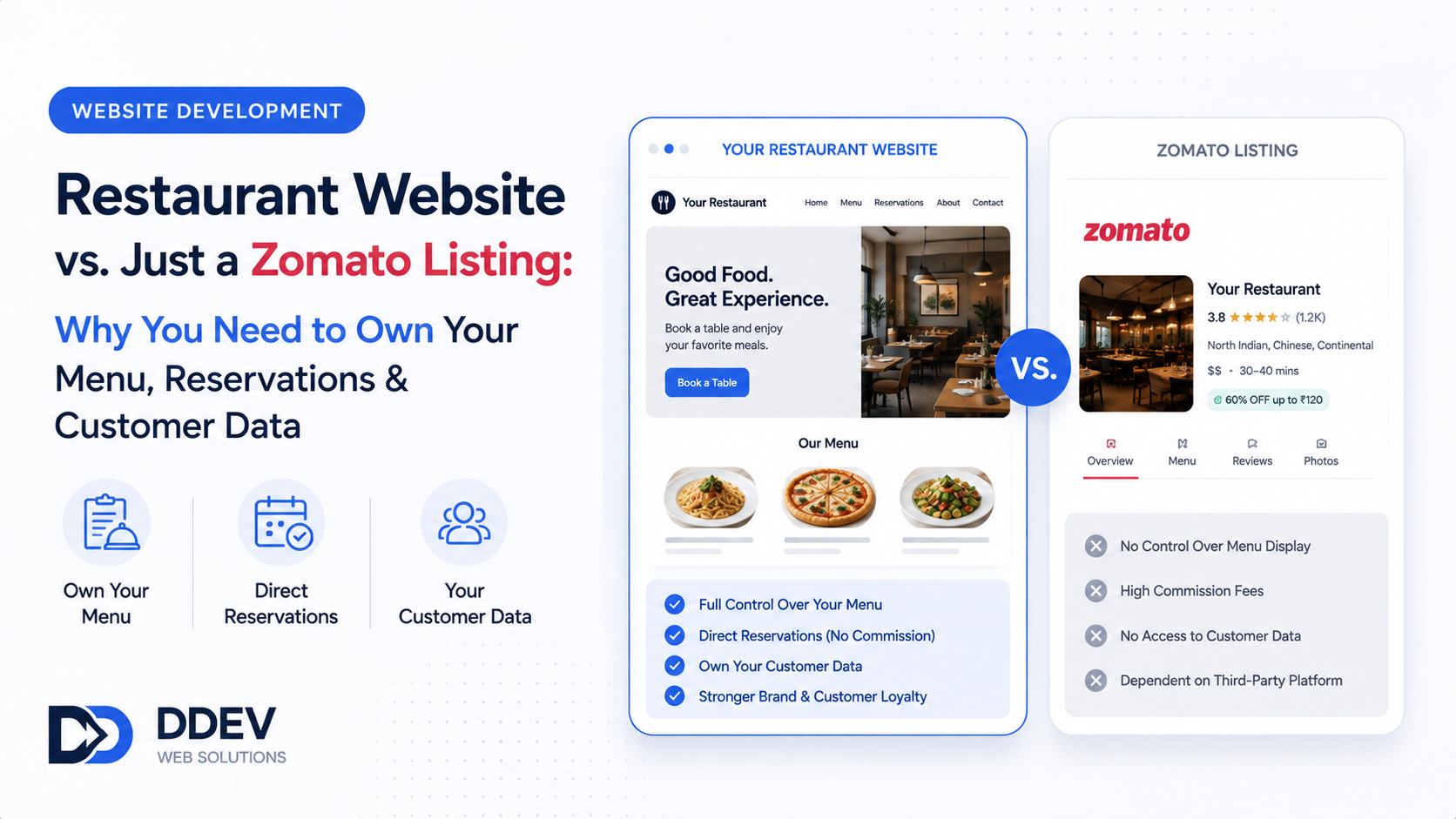
Aggregators enforce pricing constraints and discount expectations. If your competitor offers "60% off up to ₹120," the platform's algorithm favors them. You either match the discount (and fund it yourself) or accept lower visibility.
On your own website, you set prices, run promotions on your terms, and keep 100% of the revenue.
3. Brand Identity
Your Zomato listing looks like every other Zomato listing. Same layout, same fonts, same structure. Your restaurant's unique character — the story, the chef, the atmosphere — gets compressed into a standardized card alongside 50 competitors.
Your website is your brand. It looks, feels, and speaks like you.
4. Menu Presentation
On Zomato, your menu is a list of items with prices. On your website, your menu is a story — descriptions, photos, pairings, seasonal highlights, chef's specials. The menu is the most-visited page on any restaurant website. Making it compelling directly affects orders.
5. Search Visibility
Your Zomato listing ranks on Zomato. Your website ranks on Google.
When someone searches "best pizza in Bandra" on Google, Zomato's aggregated page often ranks — but individual restaurants with their own websites and proper local SEO can rank in the Local Pack too. And that listing sends traffic to you, not to a marketplace where 10 competitors sit alongside.
What a Restaurant Website Actually Does
A restaurant website is not a brochure. It is a revenue channel.
It converts Google searchers into customers. Someone searching "[your cuisine] near me" lands on your website, sees your menu, and orders — without ever touching an aggregator.
It builds a re-marketable customer database. Every order, reservation, and inquiry gives you a contact. After 6 months, you have hundreds or thousands of customers you can reach directly.
It reduces aggregator dependency. Each customer who switches to ordering direct is one less order paying 25–35% commission.
It strengthens your brand. A professional, well-designed website signals quality. Customers perceive restaurants with their own website as more established and trustworthy than those that exist only on aggregator platforms.
It gives you data. Which dishes are most viewed? What time of day do people browse your menu? Where do visitors drop off? Website analytics tell you things Zomato will never share.
The 5 Features Every Restaurant Website Needs
You do not need a complex, expensive website. You need a fast, functional one with these five things:
1. A Mobile-First Menu Page
Your menu is not a PDF. It is an HTML page that loads instantly on any phone, with dish names, descriptions, prices, and photos. It should be searchable, filterable (veg/non-veg, course type), and connected to your ordering system.
2. Online Ordering
Add to cart. Choose delivery or pickup. Pay via UPI, card, or COD. Confirm order.
This is the feature that directly saves you commission. Every order here is an order not placed on Swiggy.
3. Table Reservation
A simple date-time-party-size form with confirmation. Restaurants that accept reservations online fill more seats — especially during peak hours when phone lines are jammed.
4. WhatsApp Integration
A click-to-WhatsApp button on your website, pre-loaded with a message template. For Indian restaurants, WhatsApp is the highest-engagement communication channel — 97%+ open rates, and customers are already comfortable using it.
5. Reviews and Social Proof
Display your Google Reviews on your website. Show your rating, recent testimonials, and food photos from real customers. Social proof on your own site builds trust without redirecting visitors to a platform where they can see competitors.
The Cost Comparison: Website vs. Aggregator Dependency
| Factor | Zomato/Swiggy Only | Own Website + Aggregators |
|---|---|---|
| Commission per order | 25–35% effective | 2% (payment gateway) on direct orders |
| Customer data | Owned by platform | Owned by you |
| Repeat marketing | Not possible | WhatsApp, SMS, email |
| Brand control | Standardized listing | Fully custom |
| Monthly cost | Commission-based (variable, grows with revenue) | ₹2,000–5,000/month (fixed) |
| One-time setup | Free | ₹40,000–₹1,50,000 |
| Long-term ROI | Diminishing (more revenue = more commission) | Compounding (more direct orders = more savings) |
The math is clear: a restaurant doing ₹3–5 lakh/month in delivery revenue will save ₹6–12 lakh/year by shifting 30–40% of orders to direct.
The website is not an expense. It is the single best investment a restaurant can make in its digital future.
When a Zomato Listing Is Enough (And When It Is Not)
A Zomato listing is enough when:
- You have just opened and need discovery fast
- You do fewer than 5 delivery orders per day
- You are testing a concept and have not validated demand yet
You need your own website when:
- You do 10+ delivery orders per day (the commission is now a real cost)
- You want to build a loyal customer base you can re-market to
- You are growing and want margins to grow with revenue (not stay flat)
- You care about brand identity and want to stand out from the marketplace crowd
- You want to run your own promotions without platform restrictions
Most restaurants should have both — an aggregator listing for discovery and a website for retention and profit. The question is not "either/or." It is "what percentage of orders should flow through each channel."
The target for a mature restaurant: 30–50% of delivery orders through direct channels within 12 months.
Frequently Asked Questions
Do restaurants really need their own website in 2026?
Yes, if you do more than 10 delivery orders per day. The commission you pay to aggregators (25–35% effective) is a direct hit to your margins. A website lets you capture direct orders at 2% transaction cost and build a customer database you own.
How much does a restaurant website cost in India?
A professional restaurant website with online ordering, reservation, WhatsApp integration, and a mobile-first menu typically costs ₹40,000–₹1,50,000 to build, with ₹2,000–5,000/month in hosting and maintenance.
Will customers actually order from my website instead of Zomato?
Yes — with the right incentives. Restaurants that offer 10–15% discounts for direct orders, loyalty rewards, and consistent nudges (QR codes on tables, WhatsApp messages, bill inserts) routinely shift 20–40% of orders to direct within 6 months.
Can I have a website AND stay on Zomato?
Absolutely. The recommended strategy is to use aggregators for customer discovery and your website for repeat orders. New customers find you on Zomato; repeat customers order from your site. You pay commission once per customer, not forever.
What if I am not tech-savvy?
You do not need to be. A web development partner handles the build, hosting, and maintenance. Your job is to keep your menu updated and share the website link with customers. If you can manage a Zomato listing, you can manage a website.
Own Your Restaurant's Digital Future
DDev builds restaurant websites that do more than look good — they capture orders, build customer lists, and reduce your dependency on platforms that take 25–35% of every rupee.
Menus. Online ordering. Reservations. Loyalty. All on your domain.
Build Your Restaurant Website. Talk to DDev.