D2C vs. Marketplace in India: Should You Sell on Amazon/Flipkart or Build Your Own Store?
India's e-commerce market is growing fast. If you are a brand, here is the fundamental decision: sell on marketplaces, build your own D2C store, or do both.
India's e-commerce market is growing at 19-27% annually. Over 10,000 active D2C brands sell primarily through their own online stores. At the same time, more than 1.5 million SMBs sell on Amazon India and Flipkart combined.
If you are a brand or seller in India, you face a fundamental decision: sell on marketplaces, build your own D2C store, or do both.
The honest answer: for most brands, it is not either/or. It is a sequence. Marketplaces for discovery and initial volume. Your own store for margin, data, and brand building.
Here is why.
What Marketplaces Give You
Massive built-in traffic. Amazon India and Flipkart together receive hundreds of millions of monthly visits. Listing your product puts it in front of a ready audience without any marketing spend.
Trust and logistics. Buyers trust marketplace checkout, returns, and delivery. Fulfillment by Amazon (FBA) and Flipkart's logistics handle warehousing and shipping.
Discovery for new brands. A brand nobody has heard of can sell on Amazon because the platform's trust transfers to the seller. Your own website does not have that advantage on day one.
What Marketplaces Take Away
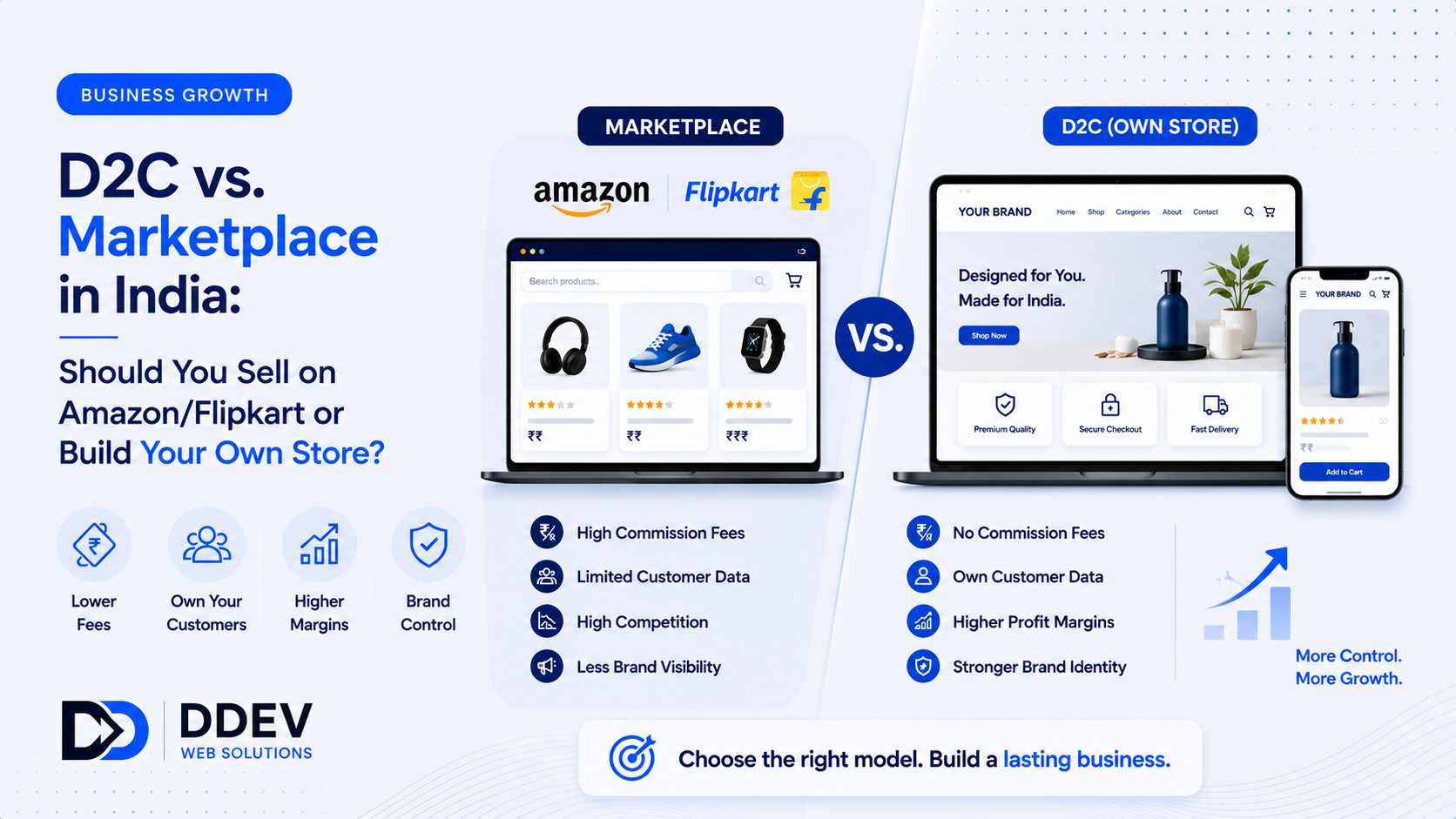
Margin. Amazon charges 5-25% commission depending on category (electronics ~8-12%, fashion ~17-22%, beauty ~8-12%). Flipkart is comparable at 4-22%. Add FBA fees, advertising spend, and return handling, and effective costs can reach 30-40%.
Customer data. The customer belongs to Amazon, not to you. You cannot email them, WhatsApp them, or build a repeat-purchase relationship outside the platform.
Brand identity. Your product listing looks like every other Amazon listing. Same layout, same fonts, same structure. Your brand story gets compressed into a bullet-point product description.
Price control. Marketplace algorithms favor lower prices. The pressure to match or undercut competitors is constant, which squeezes margins further.
What a D2C Store Gives You
Full margin. Your only costs are payment gateway (2%), hosting (₹2,000-5,000/month), and customer acquisition. No marketplace commission on any order.
Customer ownership. Every buyer's email, phone number, and order history is yours. You can build WhatsApp lists, run email campaigns, and create loyalty programs.
Brand experience. Your website looks, feels, and speaks like your brand. You control the unboxing narrative, the follow-up communication, and the entire customer journey.
Repeat purchase economics. Acquiring a customer once and selling to them repeatedly — without paying commission each time — is how D2C brands build profitability.
The Right Strategy: Marketplace + D2C Together
Phase 1: Marketplace First (Month 1-6)
If you are a new brand with no audience, start on Amazon/Flipkart. Use the marketplace for validating demand (do people actually buy your product?), generating initial reviews and social proof, learning about pricing, competition, and customer preferences, and building cash flow.
Phase 2: Launch D2C Store (Month 3-6)
While selling on marketplaces, build your own store. Start capturing direct customers through package inserts with QR codes linking to your website (with a discount incentive), Instagram and WhatsApp driving traffic to your store instead of Amazon, and email/WhatsApp marketing to past customers from direct enquiries.
Phase 3: Shift Volume to D2C (Month 6-18)
Target 30-50% of revenue through your own store within 12-18 months. Marketplace revenue continues, but the growing D2C share improves overall margins.
The math: if you do ₹10 lakh/month and shift 40% to D2C (saving 20% commission on those orders), you keep an additional ₹80,000/month — nearly ₹10 lakh/year.
What Your D2C Store Needs
- Fast, mobile-first design (80%+ of Indian e-commerce traffic is mobile)
- Modern checkout (UPI, cards, COD, wallets — no friction)
- Inventory management (sync with marketplace inventory to avoid overselling)
- Analytics (where customers come from, what they browse, where they drop off)
- WhatsApp integration (abandoned cart recovery, order updates, support)
- SEO-optimized product pages (so you attract organic traffic over time)
Frequently Asked Questions
Is D2C profitable from day one?
Usually not — customer acquisition costs (ads, influencer marketing) eat into margins initially. Profitability comes from repeat purchases. A D2C brand that acquires a customer for ₹500 and earns ₹200 margin per order needs 3 orders to break even on acquisition. After that, every order is profit.
Should I completely leave Amazon/Flipkart?
No. Marketplaces provide volume and discovery. The goal is reducing dependency, not eliminating marketplaces. Think of it as a portfolio: 50-60% marketplace, 40-50% D2C.
How much does a D2C store cost in India?
A professional D2C store with inventory management, payment integration, and analytics costs ₹60,000-₹2,50,000 to build. Monthly costs are ₹3,000-10,000. Enterprise-grade custom builds can go higher.
Build Your D2C Channel
DDev builds fast, conversion-optimized D2C stores for Indian brands — modern checkout, inventory management, analytics, and WhatsApp integration. Keep your margins. Own your customers.
Talk to DDev About Launching Your D2C Store.