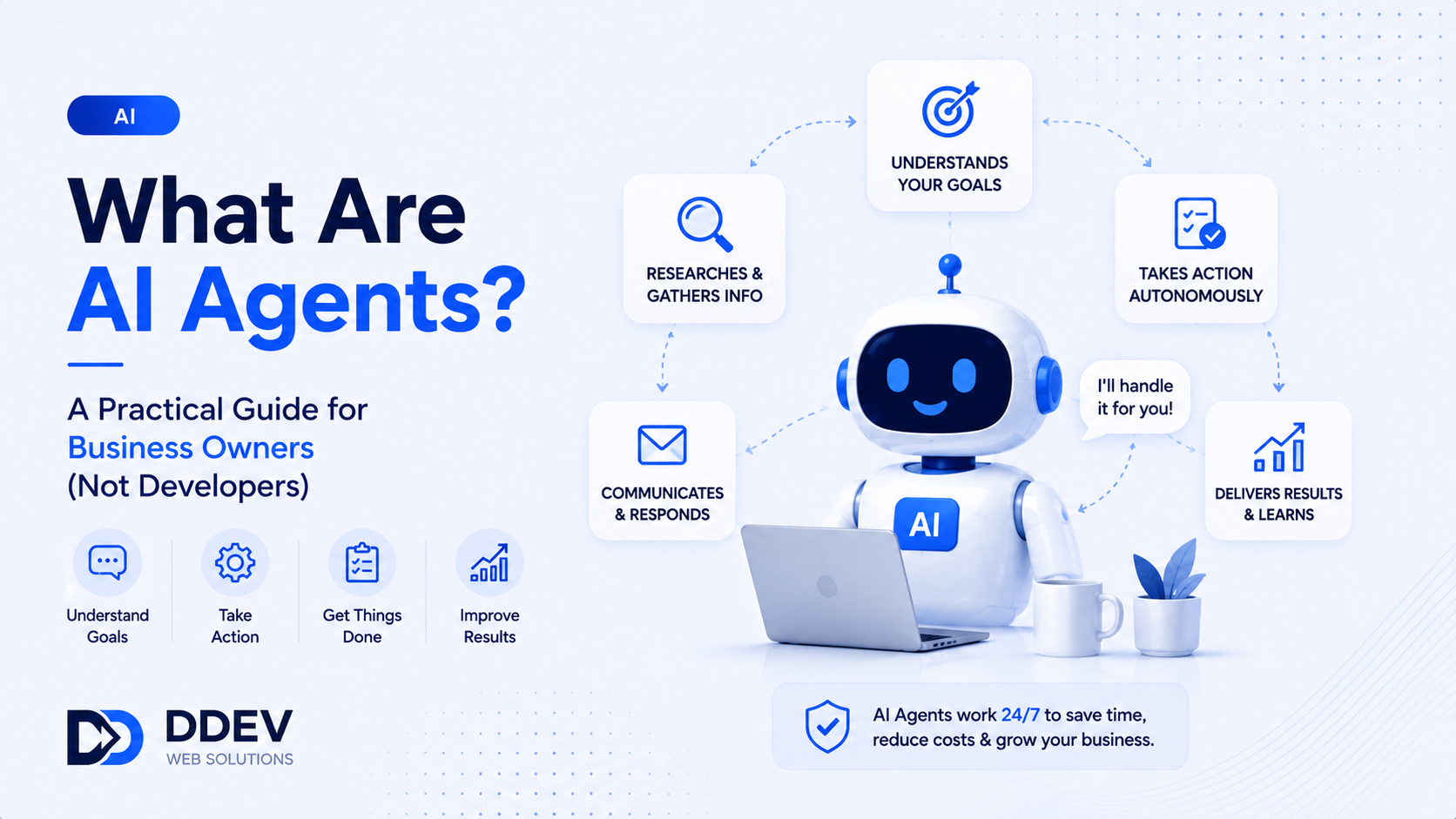
What Are AI Agents? A Practical Guide for Business Owners (Not Developers)
AI agents are not chatbots. They plan, use tools, and complete multi-step tasks on their own. Here is what that actually means for your business, in plain language.
If you have heard the term "AI agent" thrown around in the last year and quietly nodded along without being entirely sure what it means — you are not alone. It is one of the most overused and under-explained terms in business technology right now.
Here is the plain-language version.
An AI agent is software that can plan a multi-step task, decide which tools or systems it needs to use to complete that task, take those actions on its own, and remember context along the way — without a human walking it through every single step.
That is different from what most business owners think of when they hear "AI." A chatbot answers a question. An AI agent can look up an order, check inventory, draft a response, send it, and update a record — as one continuous, self-directed sequence.
The global AI agent market is now valued above $10 billion, growing at over 40% annually — one of the fastest technology adoption curves on record. But most of the coverage is written for enterprise CTOs, not for someone running a clinic, a coaching institute, or a retail store. This guide fixes that.
AI Agent vs. Chatbot: The Difference That Actually Matters
This distinction is where almost all the confusion comes from, so it is worth being precise.
A chatbot responds to what you type. Ask it a question, it answers. Ask a follow-up, it answers that too, usually within a single conversation. It does not take action outside the conversation. It does not remember your business's context after the chat ends. It does not decide what to do next on its own.
An AI agent is given a goal, not a question. "Follow up with every enquiry that has not responded in 24 hours." The agent then plans how to do that — checks which enquiries are pending, drafts a personalized follow-up message for each, sends it through WhatsApp or email, logs the response in your CRM, and flags anything that needs a human. All of that happens as one autonomous sequence, not a back-and-forth conversation with a person prompting each step.
Think of a chatbot as a very well-informed assistant who only acts when told exactly what to do. Think of an AI agent as a junior employee who can be given a goal and is trusted to figure out the steps — within boundaries you set.
Why This Term Is Suddenly Everywhere
The shift is not hype without substance. The numbers back up that something real changed recently.
A large majority of enterprises now report at least one AI agent running in a live, production system — not a pilot or an experiment — a figure that has grown sharply in just the past two years, a faster jump than almost any prior enterprise technology adoption curve, including cloud computing a decade ago.
Two industries are leading adoption by a clear margin: customer service and e-commerce. Both share the same trait — high-volume, repeatable workflows with a direct line to revenue or cost. That is exactly the profile of a task AI agents handle well, and exactly the profile of tasks most small businesses deal with daily: answering the same handful of questions over and over, following up on the same kind of enquiry, processing the same kind of booking.
Sales operations is reportedly the fastest-growing new deployment category, with the shortest reported payback period of any function — often just a few months. This matters for a business owner because it signals where the return shows up fastest, not just where the technology is most impressive.
What an AI Agent Actually Does, Step by Step
To make this concrete, here is what a customer-enquiry AI agent might actually do for a small business, end to end:
- Receives a WhatsApp message from a potential customer asking about pricing and availability
- Checks the business's current pricing, availability, or booking calendar
- Drafts a personalized response using that real, current information — not a generic canned reply
- Sends the response back through WhatsApp within seconds
- Logs the enquiry and the customer's details into a CRM or spreadsheet automatically
- Schedules a follow-up message if the customer does not respond within a set window
- Flags the conversation for a human team member only if the customer asks something outside its scope (a complaint, a custom request, a negotiation)
A human is still in the loop for anything that requires judgment. But the routine 80% of enquiries — the ones asking the same handful of questions — get handled instantly, at any hour, without anyone on your team touching them.
Real Business Use Cases (Not Hypotheticals)
Across the industries DDev works with, here is where AI agents are showing up in practical, non-theoretical ways:
Clinics and healthcare: An agent handles appointment booking enquiries, sends automated pre-visit reminders, follows up on missed appointments, and answers routine questions about timings and services — freeing front-desk staff for in-person patients.
Restaurants: An agent manages WhatsApp ordering conversations, confirms orders, sends status updates, and follows up post-delivery with a review request — all without a staff member manually managing the chat.
Real estate: An agent qualifies inbound leads by asking about budget, location preference, and timeline before handing a warm, pre-qualified lead to an agent — instead of an agent manually screening every enquiry.
Coaching institutes: An agent responds to course enquiries instantly with fee details and batch timings, and runs the follow-up sequence with prospective students automatically, even outside office hours.
Hospitality: An agent handles the pre-arrival messaging sequence — sending upgrade offers, logistics information, and check-in details — timed automatically based on each guest's booking date.
Professional services: An agent handles routine document requests and status updates for clients, freeing the professional's time for actual case or advisory work.
None of these require the business to build custom AI infrastructure from scratch. They are increasingly available as configured workflows layered on top of a well-built website, CRM, and WhatsApp Business integration.
The Honest Gap: Adoption vs. Real Value
It is worth being direct about something most AI coverage glosses over: a lot of AI agent adoption right now is still experimental, not scaled.
Across enterprise surveys, a majority of organizations report having experimented with AI agents, but a much smaller share — often under a quarter — say they have scaled an agent to deliver real, measurable value. Data quality and unclear ownership of the workflow are consistently cited as the biggest reasons deployments stall.
This is not a reason to avoid AI agents. It is a reason to be specific rather than vague about what you want one to do. The businesses seeing real results are not the ones that deployed "an AI agent" in the abstract — they are the ones that automated one clearly defined, repeatable task (enquiry follow-up, appointment reminders, order confirmations) and measured whether it actually saved time or improved response rates.
Start narrow. Prove it works on one workflow. Expand from there.
What an AI Agent Needs to Actually Work
An AI agent is not magic layered on top of nothing. For it to function well, it needs clean, structured data — if your customer information, bookings, and pricing live in scattered WhatsApp chats and paper registers, an agent has nothing reliable to work from, so a proper website with structured booking and customer data is the foundation.
It also needs a clearly defined task. "Handle customer service" is too vague. "Respond to pricing enquiries with current rates and log the contact" is a task an agent can actually be built to do well.
It needs integration with your existing tools — connecting to your WhatsApp Business account, your booking system, your CRM, not operating in isolation.
And it needs a human fallback. Anything outside the agent's defined scope should route to a real person. This is what separates a well-built agent from a frustrating dead-end chatbot experience.
Should Your Business Use One Yet?
A useful way to decide: look at your own operations and ask where you are answering the same handful of questions, sending the same kind of follow-up, or manually logging the same kind of information, over and over, every single day.
If that pattern exists — and for most SMBs handling enquiries, bookings, or orders, it does — that is where an AI agent earns its cost fastest. It is not about replacing your team. It is about removing the repetitive 80% so your team's time goes toward the judgment calls only a person can make.
If your business does not yet have consistent digital enquiry volume — if most business still happens by walk-in or phone with low repeat patterns — building a proper website and digital presence first is the right sequencing. An AI agent needs a digital workflow to plug into; it cannot create one from nothing.
Frequently Asked Questions
Is an AI agent the same as a chatbot?
No. A chatbot responds to messages within a conversation. An AI agent is given a goal and autonomously plans and executes a multi-step sequence of actions — checking information, taking action, logging results — without needing a person to direct each step.
How much does it cost to add an AI agent to a small business?
Costs vary widely based on complexity, but a well-scoped single-workflow agent (e.g., WhatsApp enquiry handling with CRM logging) is typically far more affordable than most business owners assume, especially compared to the ongoing cost of a dedicated staff member handling the same repetitive task.
What is the biggest reason AI agent projects fail?
Vague scope and poor underlying data, based on enterprise research. Businesses that try to automate an entire function ("customer service") rather than one specific, well-defined task tend to stall. Starting narrow and specific consistently produces better results.
Do I need a developer to set up an AI agent for my business?
For most SMB use cases (enquiry handling, booking follow-up, appointment reminders), these are increasingly available as configured solutions built on top of your website and existing tools, rather than something built entirely from scratch.
What should I automate first?
Whichever repetitive task currently consumes the most staff time with the least judgment required — commonly initial customer enquiry response, appointment/booking follow-up, or order confirmation and status updates.
Automate the Repetitive Work. Keep the Judgment Calls Human.
DDev builds websites with AI-agent-ready infrastructure — structured booking systems, WhatsApp integration, and CRM connections that make automated enquiry handling, follow-up, and reminders actually possible.
Talk to DDev About AI Agents for Your Business.