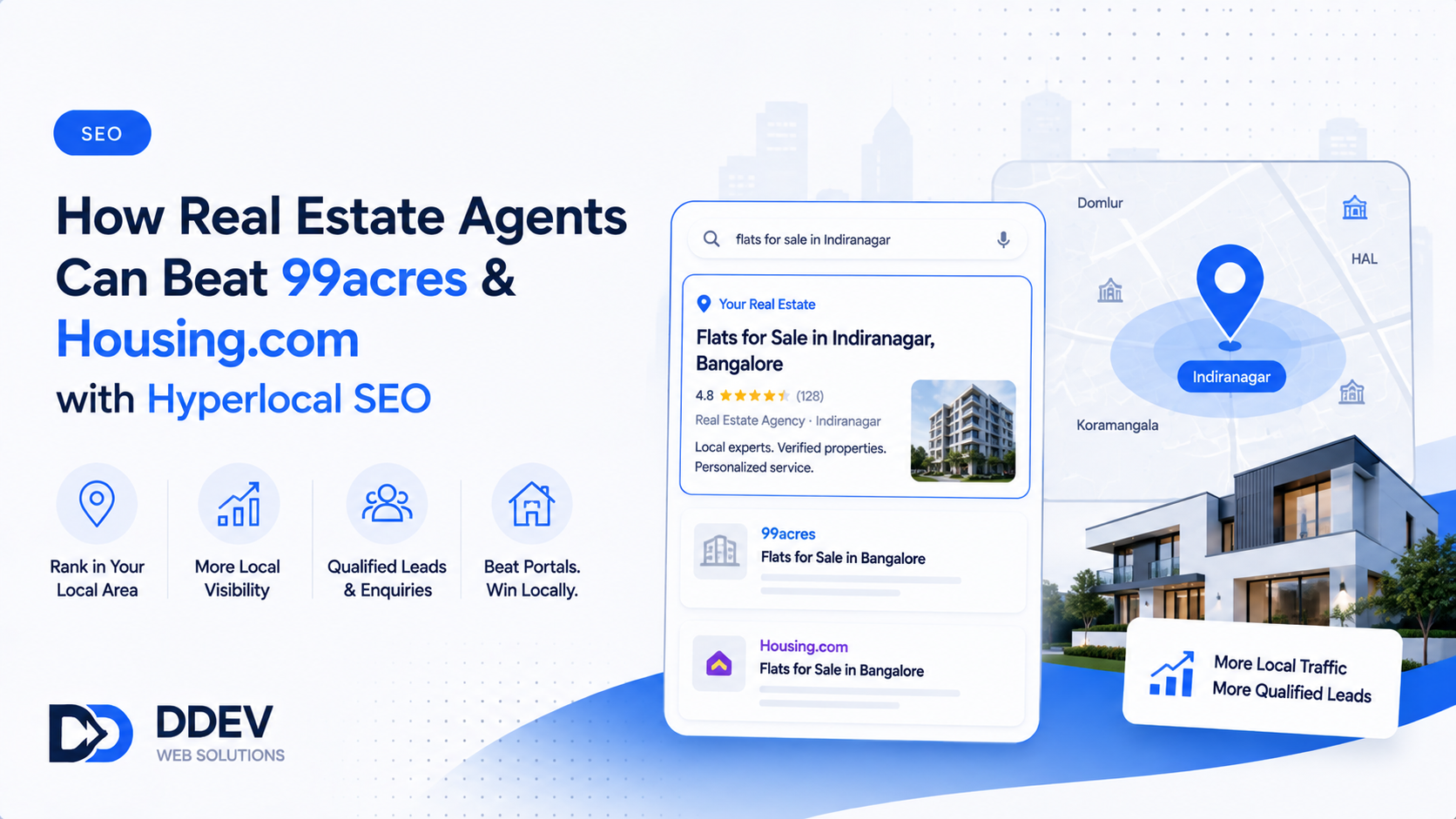
How Real Estate Agents Can Beat 99acres & Housing.com with Hyperlocal SEO
You cannot outrank 99acres for 'flats in Mumbai.' But you can own neighborhood-level searches that portals structurally cannot. Here is the hyperlocal SEO playbook.
Here is the uncomfortable truth about real estate SEO: you will not outrank 99acres, Housing.com, or MagicBricks for "flats in Mumbai" or "2BHK in Gurgaon."
These portals have domain authority above 80, thousands of pages, millions of backlinks, and dedicated SEO teams. Competing head-on is a waste of time and money.
But here is what those portals cannot do: write about a specific neighborhood with the depth, authority, and local knowledge that a local agent has.
99acres can list 500 flats in Koramangala. It cannot write "What It Is Actually Like Living in Koramangala 4th Block — Schools, Traffic, Water Supply, and Price Trends."
That is your winning keyword. And it is the keyword that serious buyers — the ones who have narrowed down to a neighborhood — actually search for.
Why You Cannot Outrank the Portals (And Why You Do Not Need To)
| Factor | 99acres | Your Agency Website |
|---|---|---|
| Domain Authority | 85+ | 10-25 (typical) |
| Indexed Pages | Millions | 20-50 |
| Backlinks | 100,000+ | 50-200 |
For broad terms like "flats in Pune," the portal wins every time. Fighting this battle is like opening a kirana store and trying to beat Amazon on selection. Wrong game.
The Hyperlocal Advantage
Portals are broad. You need to be deep.
A portal listing for Koramangala shows property cards — price, size, photos. It does not tell a buyer which blocks have better water supply, where traffic bottlenecks during school hours, what the actual parking situation looks like, or how prices moved block-by-block over the last 3 years.
You know these things because you work in these neighborhoods daily. This knowledge is your content moat.
Neighborhood pages — deep, detailed guides to specific localities — rank for long-tail queries that portals do not target. And they convert better because the reader is further along in their buying journey.
Someone searching "flats in Bangalore" is browsing. Someone searching "is Koramangala 4th Block good for families" is buying.
Building Neighborhood Pages That Rank
Each neighborhood page should be a comprehensive, genuinely useful guide:
Overview: Location context, vibe, who lives here, what makes it distinctive.
Property Market Snapshot: Average price per sq ft, price trend over 2-3 years, property types available, new vs. resale mix.
Connectivity: Commute times to key business districts, nearest metro, major roads, airport distance. Include real commute times, not just distances.
Social Infrastructure: Named schools with ratings, hospitals, malls, parks, grocery options. Be specific — "DPS East is 1.2 km away" beats "good schools nearby."
Lifestyle: What daily life looks like. Morning walks, weekend activities, food scene, community feel. Content portals cannot create because it requires lived experience.
Pros and Cons: Be honest. If water supply is inconsistent or traffic is bad, say so. Honesty builds trust — and trust is what makes someone call you instead of the portal.
Recommendations and CTA: "Based on our experience working in [neighborhood]..." and a contact form.
Target keywords:
- "[Neighborhood] property guide"
- "living in [neighborhood] [city]"
- "is [neighborhood] good for families"
- "[neighborhood] property prices [year]"
- "best areas in [neighborhood] to buy a flat"
The Agent-Identity Play
Portals cannot build a personal brand for you.
When a buyer searches "best real estate agent in Whitefield" or "[your name] reviews," your website should rank. Create an agent profile page with your track record, neighborhoods served, transaction count, client testimonials, and video introductions.
A buyer who has read your neighborhood guide and seen your testimonials calls you as a trusted advisor, not a random agent.
Google Business Profile for Realtors
Category: "Real Estate Agent" or "Real Estate Agency"
Service areas: Every neighborhood you actively work in
Photos: Properties, office, team, client closings
Reviews: Actively collect from past clients. Reviews mentioning specific neighborhoods boost local relevance.
Posts: Weekly updates about listings, market trends, or neighborhood insights.
Content That Converts Buyers and Sellers
Market updates: "Q2 2026 Property Prices in [City]: What Changed and Why" — positions you as a market expert.
Buyer guides: "First-Time Home Buyer Guide for [City]" — captures top-of-funnel traffic.
Comparison pages: "[Neighborhood A] vs [Neighborhood B]: Which Is Better for Investment?" — addresses common buyer dilemmas.
Calculator tools: EMI calculator, stamp duty calculator, rental yield calculator — interactive content that drives engagement and captures leads.
Frequently Asked Questions
Can a small agency really rank on Google against 99acres?
Not for broad terms. But for neighborhood-level, question-based, and agent-specific queries, yes. These long-tail searches have less competition and higher buyer intent.
How many neighborhood pages should I create?
Start with 3-5 neighborhoods you know best. Each page should be 1,500-2,500 words of genuinely useful content. Quality over quantity.
How long before real estate SEO shows results?
3-6 months for meaningful ranking improvements. GBP optimization shows faster results (4-8 weeks).
Own Your Neighborhoods Online
DDev builds real estate websites with hyperlocal SEO — neighborhood pages, property listings, lead capture forms, and CRM integration that turns search traffic into serious buyer and seller leads.
Talk to DDev About Dominating Your Local Market.