Direct Bookings vs. OTAs: How Independent Hotels Can Cut Commission and Keep the Guest
OTAs take 15-25% per booking. Direct bookings cost 2-5%. For a 30-room hotel, the difference is ₹25-40 lakh/year. Here is the math and the strategy.
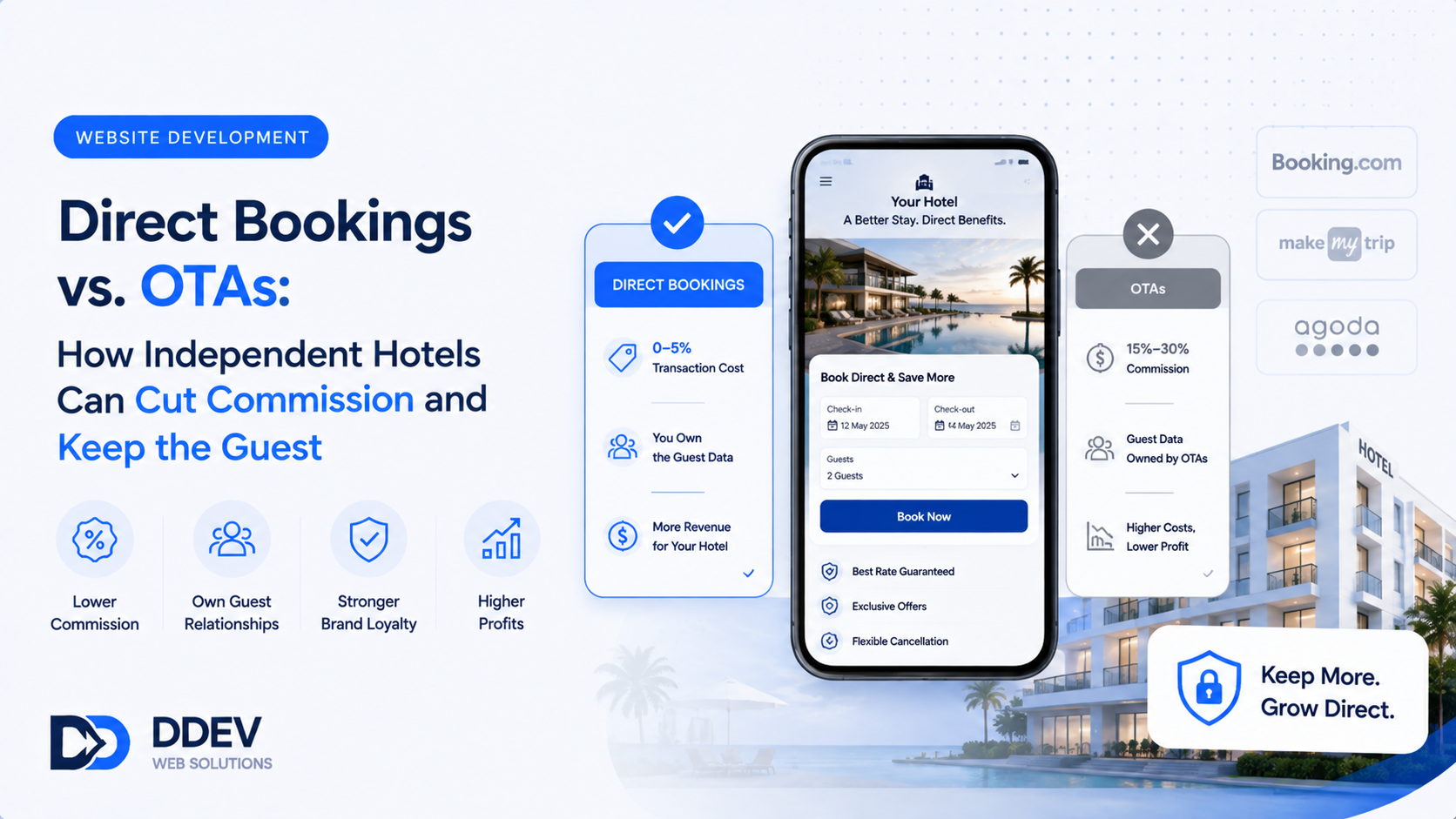
Every time a guest books your hotel on MakeMyTrip, you pay 15-25% commission. On Booking.com, 15-18%. On Agoda, 18-25%.
For a 30-room hotel running at 70% occupancy with an ADR (Average Daily Rate) of ₹3,000, that commission adds up to ₹25-40 lakh per year — depending on your OTA mix and negotiated rates.
That money does not buy you loyalty, guest data, or a direct relationship. It buys you a one-time transaction on someone else's platform.
Direct bookings — where the guest books on your hotel's own website — cost roughly 2-5% (payment gateway fees). The guest relationship, the data, and the profit stay with you.
This is not an argument to abandon OTAs. They are excellent discovery engines. But every hotel that treats OTAs as the only booking channel is leaving lakhs on the table.
The strategy is simple: use OTAs for discovery, your website for conversion.
The Commission Math
| Platform | Commission Range (2026) | On ₹5,000 Booking |
|---|---|---|
| MakeMyTrip/Goibibo | 15-25% | ₹750-1,250 |
| Booking.com | 15-18% | ₹750-900 |
| Agoda | 18-25% | ₹900-1,250 |
| Direct Website | 2% (payment gateway) | ₹100 |
| Savings per direct booking | ₹650-1,150 |
For a 30-room hotel at 70% occupancy (21 rooms/night × 365 = 7,665 room-nights/year):
At ₹5,000 ADR and 20% average OTA commission: ₹76.65 lakh in annual commission.
If you shift 30% of bookings to direct: ₹23 lakh saved per year.
That is not incremental revenue. That is pure margin recovery.
Why OTAs Still Matter
OTAs are not the enemy. They serve three legitimate functions:
Discovery. Most travelers start their search on OTAs. They compare destinations, prices, and reviews. Being listed is essential for visibility.
Trust. OTA reviews and ratings build trust for properties that are not well-known brands. A 4.5-star rating on Booking.com carries weight.
International reach. For hotels that attract international travelers, OTAs provide distribution across global markets that no independent website can match.
The mistake is letting OTAs be the only channel. The guest who discovers you on MakeMyTrip should eventually book directly on your website.
Building a Direct Booking Channel
1. A Fast, Mobile-First Hotel Website
70% of Indian hotel bookings happen on mobile. Your website must load in under 3 seconds, show rooms and pricing clearly, and have a visible "Book Now" button.
2. A Booking Engine
A booking engine integrated into your website lets guests check availability, select room types, pick dates, and pay — all without leaving your site. This is the critical infrastructure that makes direct booking possible.
Modern booking engines sync with your PMS (Property Management System) for real-time availability and with your channel manager for rate parity.
3. "Book Direct" Incentives
Rate parity agreements with OTAs prevent you from offering a lower public rate. But you can offer:
- Free breakfast for direct bookings
- Room upgrades subject to availability
- Late checkout as a direct-only perk
- Loyalty points for future stays
- Member-only rates (require free registration for access)
Same room rate. More value. Guest books direct.
4. Google Hotel Ads
Google's hotel search shows your property alongside OTAs. If your booking engine is connected, your direct rate appears with a "Book on [Hotel Name]" link. Guests see the price comparison and often choose the hotel's own site, especially when direct perks are highlighted.
5. Guest Communication Post-Booking
Once a guest books via OTA, they receive your confirmation email. Use this touchpoint to introduce your website and direct booking benefits: "For your next stay, book directly at [website] for complimentary breakfast and priority upgrades."
Convert every OTA guest into a future direct booker.
The Guest Data Advantage
When a guest books on MakeMyTrip, MakeMyTrip owns the relationship. You get a reservation, but limited guest data.
When a guest books direct, you own everything: email, phone, preferences, travel dates, room preferences, special requests.
This data powers:
- Pre-arrival upsells (room upgrades, spa packages, experiences)
- Personalized stays (welcome amenity based on past preferences)
- Post-stay marketing (return offers, seasonal promotions)
- Loyalty programs (track stays, reward frequency)
A guest who books direct once and has a personalized experience is far more likely to return — and to book direct again.
The 12-Month Direct Booking Roadmap
Months 1-3: Launch a fast, mobile-first website with a booking engine. Offer one clear "book direct" incentive (e.g., free breakfast). List on Google Hotel Ads.
Months 4-6: Start email marketing to past guests. Build a WhatsApp broadcast list. Introduce a simple loyalty program (stay 3 times, get a room upgrade).
Months 7-9: Analyze which OTA segments convert to direct. Invest more in Google Ads for brand searches ("[Your Hotel Name] book"). Create seasonal direct-only packages.
Months 10-12: Target 25-30% direct booking share. Optimize based on data — which incentive converts best, which email subject lines get opens, which packages sell.
Hotels starting from zero direct bookings typically reach 25-30% in year one with consistent execution.
Frequently Asked Questions
Will OTAs penalize me for pushing direct bookings?
OTAs enforce rate parity (same public rate across channels). They do not prevent you from offering value-adds (breakfast, upgrades) to direct bookers. As long as the base rate matches, you are compliant.
How much does a hotel booking website cost?
A professional hotel website with an integrated booking engine costs ₹80,000-₹2,50,000. Monthly costs include hosting (₹2,000-5,000) and booking engine fees (transaction-based or flat monthly). The investment typically pays for itself within 3-4 months through saved OTA commission.
When does a hotel booking website pay for itself?
At ₹5,000 ADR and 20% OTA commission, each direct booking saves ₹900-1,000. If the website costs ₹1,50,000 to build, it pays for itself after approximately 150-170 direct bookings — achievable within 2-4 months for most properties.
Keep More of What You Earn
DDev builds hotel booking websites with integrated booking engines, Google Hotel Ads connectivity, and guest communication systems that shift bookings from OTAs to direct — saving you lakhs in commission every year.
Talk to DDev About Your Direct Booking Channel.